
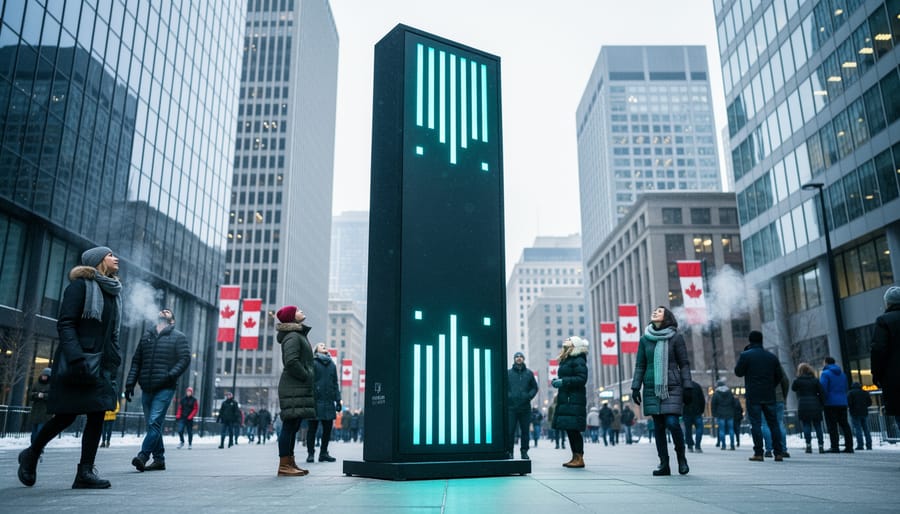
A climate change clock is a digital countdown that displays how much time remains to take decisive action before global warming reaches a critical tipping point, typically measured against the goal of limiting temperature rise to 1.5 degrees Celsius above pre-industrial levels. Far from being just another awareness campaign, it functions as what the Human Impact Lab calls “a public line in the sand” and “a measuring stick by which we can evaluate our progress” on climate commitments.
The concept has gained traction across Canada, with institutions like Concordia University projecting climate clocks onto campus buildings and cities incorporating them into Climate Week programming. According to the Climate Clock website, this tool “tells us what we need to do by when,” transforming abstract climate science into an immediately understandable visual that cuts through complexity and complacency.
What makes climate clocks particularly effective is their dual message. While the primary countdown creates urgency, many versions also track positive metrics like renewable energy adoption and climate funding, offering a more complete picture of both the challenge and the progress being made. The Climate Clock project describes it as “a powerful tool for change” and provides resources including Action Clocks, Monument Clocks, and embeddable widgets to help communities and organizations integrate the countdown into their own climate engagement efforts.
For Canada, racing toward its net-zero commitments, the climate clock serves as more than a stark reminder. It’s a daily call to innovation, a checkpoint for policy effectiveness, and a rallying point for the kind of collective action that transforms deadlines into breakthroughs. The question isn’t whether we have time. It’s what we’ll do with the time that remains.
What the Climate Change Clock Actually Tells Us
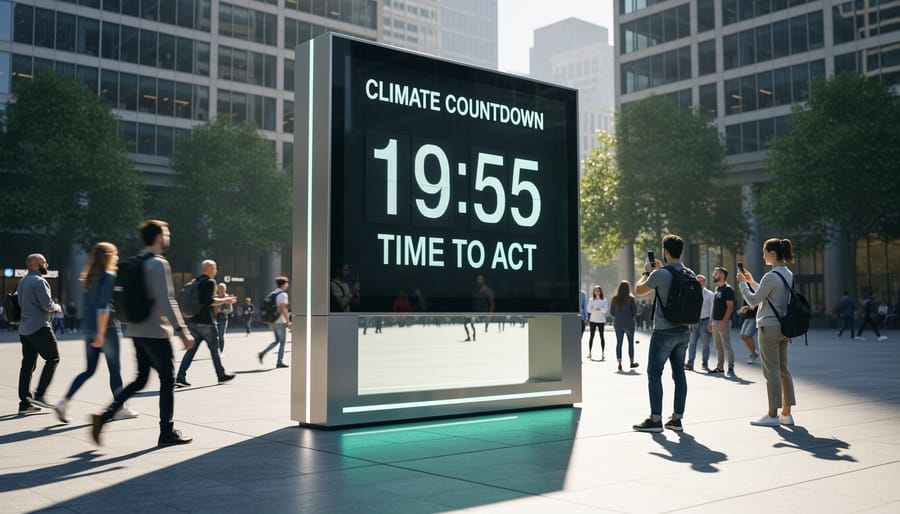
At its core, the Climate Clock is exactly what it sounds like: a countdown. But instead of ticking toward midnight on New Year’s Eve, it marks something far more consequential, the estimated time remaining before we cross critical climate thresholds that could trigger irreversible damage to our planet’s systems.
The Climate Clock tells us what we need to do by when.
That simple mission statement, from the Climate Clock website itself, captures the tool’s dual purpose. It’s both a warning and a roadmap, designed to translate abstract climate science into something immediate and visceral. The Human Impact Lab, which helped develop the project, describes it as “a public line in the sand”, a clear marker that says, this is the deadline we’re racing against.
But the Clock doesn’t just count down. It also counts up, tracking the percentage of global energy now coming from renewable sources. This dual display transforms the tool from a doom-scroller into what its creators call “a measuring stick by which we can evaluate our progress.” You can see both the urgency and the momentum in a single glance.
The Clock comes in different formats to serve different purposes. The Monument Clock, the version projected onto Concordia University’s building during Climate Week, creates an unavoidable public presence in our urban landscapes. The Action Clock serves organizers and campaigners who need to frame climate advocacy around specific deadlines. There’s even a Clock Widget that organizations can embed on their websites, democratizing access to this urgency messaging.
What makes the Climate Clock powerful isn’t complex methodology or proprietary data. It’s the psychological shift that happens when you see time running out in real numbers. Suddenly, “long-term climate goals” become this year’s budget decisions, this quarter’s investment priorities, today’s personal choices. The Clock transforms climate action from someday to now.
Why Canada Is Embracing the Climate Clock Movement
Canada’s climate urgency has found a powerful new symbol. When Concordia University projected a climate change clock onto one of its buildings, the installation became more than just numbers on a wall, it represented a nationwide awakening to the finite nature of our climate opportunity.
The timing matters. Canada committed to reaching net zero by 2050, but translating that distant deadline into daily urgency has proven difficult. Visual countdown tools like the Climate Clock bridge this gap by making abstract timelines visceral and immediate. You can walk past a policy document. You can’t ignore a ticking clock on the side of a building.
During Climate Week, the installation sparked conversations across campus and beyond. Students stopped to photograph it. Professors incorporated it into lectures. Local media covered the projection, extending its reach far beyond Concordia’s walls. That ripple effect demonstrates why Canadian institutions are embracing this movement, the clock transforms passive awareness into active conversation.
Canada faces unique climate pressures that make countdown tools particularly resonant. Our vast geography means climate impacts vary dramatically by region: coastal communities confront rising seas while prairie farmers navigate drought and flooding. The permafrost thaw in northern territories accelerates faster than global averages. Indigenous communities watch traditional lands transform within a single generation. A universal countdown creates shared urgency across these diverse experiences.
The Climate Clock also aligns with how Canadians are already turning climate commitments into action. Provincial renewable energy targets, corporate sustainability pledges, and municipal climate plans all hinge on deadlines. The clock makes those deadlines visible and democratizes access to climate urgency messaging, you don’t need to read policy papers to understand that time is running short.
What makes the Climate Clock movement stick in Canada is its refusal to let climate action remain theoretical. The projection at Concordia, the installations during Climate Week, these aren’t abstract art pieces. They’re public accountability mechanisms that ask a simple question every time someone walks past: What did you do today?
From Awareness to Action: How the Clock Drives Change

The Climate Clock isn’t meant to simply count down in silence. It’s designed to galvanize specific actions, providing communities, organizations, and governments with a tangible reference point for climate mobilization. When cities like Vancouver commit to transitioning their fleets to electric buses the Clock offers a framework for measuring whether those rollouts are happening fast enough. It transforms abstract climate targets into deadlines with real consequences.
Canadian communities are using the countdown as scaffolding for concrete initiatives. Universities planning carbon-neutral campus upgrades can benchmark their timelines against the Clock’s projections. Municipalities advocating for energy-efficient infrastructure funding use it to demonstrate urgency to provincial and federal decision-makers. Youth climate groups deploy the Clock’s imagery in campaigns, turning a scientific threshold into a rallying cry that resonates across generations.
The resources available through the Climate Clock platform support this shift from awareness to intervention in several ways:
- Planning time-bound climate actions with clear milestones aligned to the remaining window
- Measuring institutional progress against science-based targets rather than arbitrary corporate timelines
- Creating documented urgency for policy changes when decision-makers delay
- Mobilizing grassroots engagement through shareable visual tools that communicate stakes instantly
- Amplifying advocacy voices with unified messaging tied to a globally recognized symbol
What makes the Clock particularly effective in Canada is its ability to connect local efforts to a global movement. A climate strike in Halifax, a renewable energy co-op in Saskatchewan, or an Indigenous-led conservation project in the Yukon all share the same countdown. This unified timeframe helps disparate groups coordinate pressure campaigns, celebrate milestones together, and hold institutions accountable to the same non-negotiable deadline. The Clock doesn’t just remind us time is running out, it helps us organize what we do with the time we have left.
Digital Tools and Physical Installations: Making Time Visible
The Climate Clock exists in multiple forms, each designed to meet communities and organizations where they are. The Monument Clock, the version projected onto Concordia University’s wall and displayed at Climate Week events, transforms buildings into public statements. These large-scale installations turn abstract deadlines into impossible-to-ignore visual reminders, making climate urgency part of the daily landscape for anyone passing by.
For organizations planning climate events or campaigns, the Action Clock offers a focused countdown tool. It’s designed specifically for gatherings where timing matters, creating a shared sense of urgency among participants. Whether it’s a rally, conference, or community meeting, the Action Clock frames the event within the broader climate timeline.
The most accessible option is the Clock Widget, which anyone can embed on a website. This digital version democratizes the movement, allowing small nonprofits, schools, student groups, and individual activists to display the same countdown that appears on major installations. A community garden collective in Victoria can show the same deadline as a university research centre in Montreal.
This multi-format approach reflects the Climate Clock’s core philosophy: climate urgency shouldn’t be reserved for those who can afford monument-scale installations or attend major events. By offering free digital tools alongside physical displays, the platform ensures that “a public line in the sand” remains genuinely public. The Clock Widget, in particular, has enabled thousands of organizations to integrate climate deadlines into their everyday communications.
Each format serves the same purpose, making time visible, but reaches different audiences through different channels, spreading climate awareness across Canada’s diverse communities.
What Canadian Innovators Are Saying About Climate Deadlines

Canadian climate leaders view countdown tools through different lenses, shaped by scientific rigor, economic pragmatism, and cultural wisdom. Dr. Catherine Abreu, executive director of Destination Zero, calls deadline-focused messaging “a necessary wake-up call” but cautions against framing climate action as a single finish line. “We need that urgency to cut through complacency,” she explains, “but the real work continues well past 2030 or 2050. This isn’t about crossing a threshold and declaring victory.”
Clean energy researchers at the University of British Columbia emphasize how visual countdowns help translate abstract carbon budgets into something tangible. “Numbers like ‘limiting warming to 1.5 degrees’ don’t resonate emotionally for most people,” says renewable energy economist Dr. James Meadowcroft. “But showing time running out? That creates the psychological pressure needed to accelerate investment in wind farms, grid modernization, and green hydrogen projects.” He warns, however, that Canada can’t afford to miss the bus on clean energy opportunities while debating perfect timelines.
Indigenous climate advocates offer a contrasting perspective rooted in long-term stewardship rather than countdown anxiety. Eriel Deranger, executive director of Indigenous Climate Action, points out that her community has been tracking environmental change for generations without digital clocks. “Our teachings tell us to consider seven generations ahead, not seven years,” she says. “The Climate Clock can be useful for mobilizing policy action now, but it risks creating panic instead of the thoughtful, relationship-based planning that actually sustains ecosystems.”
The most effective approach, according to climate communication specialist Dr. George Marshall, combines urgency with agency. “Countdown tools work when paired with clear pathways forward,” he notes. “Show people the deadline, yes, but immediately follow with what they can do about it, support renewable energy projects, advocate for stronger building codes, invest in local food systems. Hope and urgency aren’t opposites; they’re partners in driving transformation.”
The Climate Clock isn’t just ticking down to a deadline. It’s counting up toward possibility.
Canada’s clean energy sector is already proving that transformation happens faster than pessimists predict. From offshore wind farms in Nova Scotia to geothermal projects in Saskatchewan, Canadian innovators are rewriting what’s achievable when urgency meets ingenuity. The clock projected onto Concordia University’s wall during Climate Week wasn’t installed to paralyze us with fear. It was put there to galvanize action, to serve as what the Human Impact Lab calls “a public line in the sand” that measures our progress toward the future we’re building.
Every countdown creates a choice. We can see the numbers and feel overwhelmed, or we can recognize them as the clearest possible brief for the work ahead. The Climate Clock tells us what we need to do by when, and Canada’s response has been to accelerate innovation, not retreat into despair. Our transition to net zero isn’t a sacrifice. It’s an economic opportunity, a chance to lead in technologies the whole world will need.
The most powerful thing about a visible deadline is how it cuts through complacency. Set your own clock. Whether you’re an engineer developing battery storage, a policy maker shaping municipal climate plans, or a citizen choosing where to invest your energy, the time for incremental thinking has passed. Canada’s climate future will be determined by the actions we take now, while the numbers still give us room to succeed.