
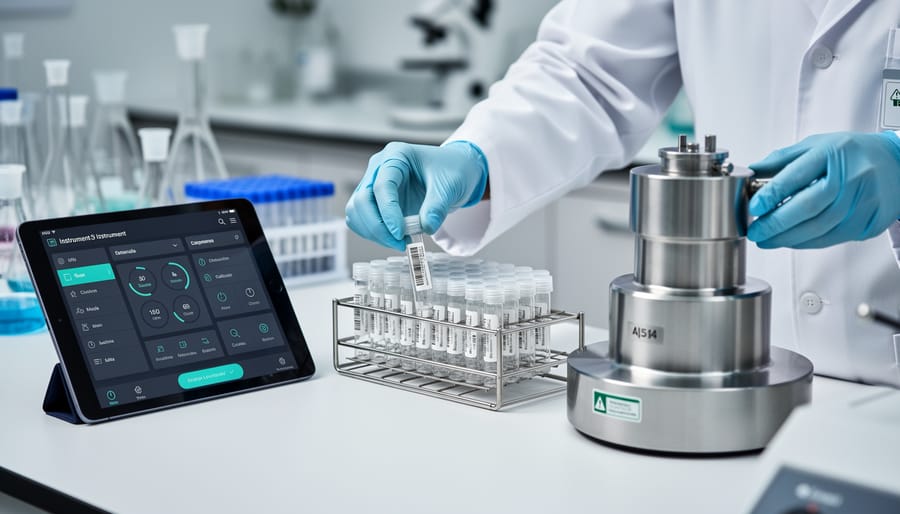
Clean technology labs and peptide chemists rely on the same core instruments to prove a sample is what they say it is: high-performance liquid chromatography (HPLC), mass spectrometry, and a few supporting tools that measure moisture, identity, and trace contamination. A battery-materials chemist checking electrolyte purity and a peptide chemist confirming a synthesis such as Researched Peptides BPC-157 are asking one question. Is the compound pure, and can I show it?
The method is learnable in a single afternoon with the right equipment. You prepare a clean sample, run it through a separation instrument, read the resulting peaks, then confirm identity with a second technique. Difficulty is moderate. The main prerequisite is access to a calibrated instrument, which is where Canada’s shared research facilities come in. Many universities and innovation hubs now open their analytical suites to startups, educators, and smaller labs, so you don’t need a seven-figure budget to test like a professional.
Why does this overlap matter for sustainability? Better purity testing means less wasted material, fewer failed batches, and faster progress on technologies like solid-state batteries, green hydrogen catalysts, and bio-based materials. Precision is a quiet form of efficiency. Below, you’ll find the toolkit, the safety basics, a step-by-step process, and the checks that tell you whether your results can be trusted.
Why a Battery Lab and a Peptide Lab Reach for the Same Instruments
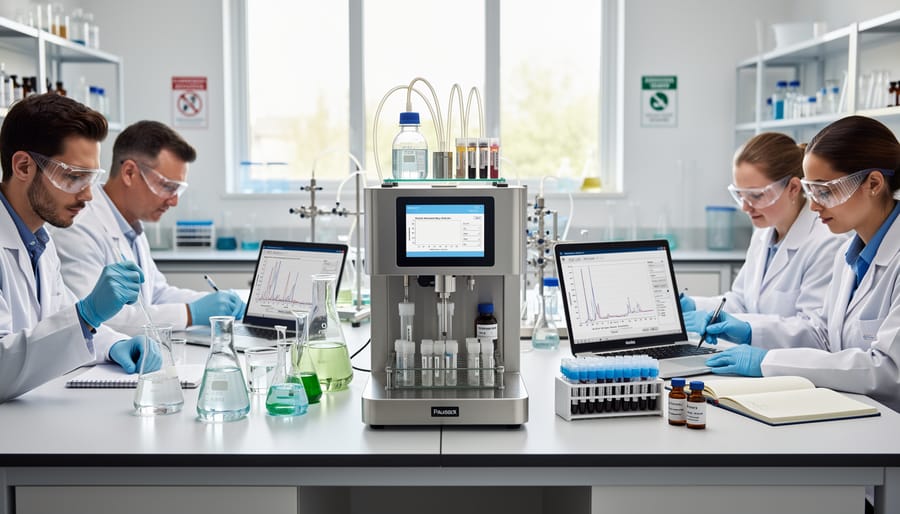
What “Purity” Actually Means in Each Field
Percent purity is the share of a sample that is the thing you meant to make. A peptide batch reported at 98% purity means 98% of the measured material is the target sequence, and the rest is something else. That “something else” is where the two fields start to differ.
Peptide chemists worry most about organic impurities: truncated chains, deletion sequences, isomers (molecules with the same atoms arranged differently) and degradation products that form as a sample ages. They also track residual solvents and leftover trifluoroacetic acid from synthesis. An acceptable result usually means a high main peak, identified impurities, and a mass that matches the expected value.
Clean technology labs care just as much, but often about different contaminants. Trace metals, measured in parts per million or even parts per billion, can quietly wreck a battery electrolyte or poison a hydrogen catalyst. Water content matters too, since moisture reacts with lithium salts. Here, acceptable usually means staying below a stated ceiling for each named element.
Getting this right is becoming a real competitive advantage for Canadian teams, and it underpins the broader clean energy revolution. In both fields, “pure” is never absolute. It is a measured, documented limit set for a specific purpose.
Tools and Materials: The Shared Purity Testing Toolkit
Consumables and Reference Materials You Cannot Skip
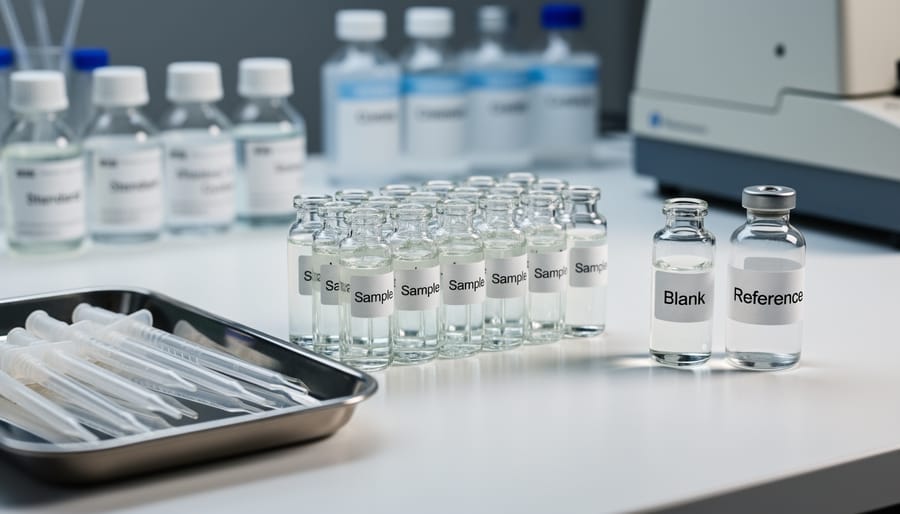
A purity result is only as good as what goes into the instrument alongside the sample. A flawless HPLC or ICP-MS can still return a misleading number if the solvent carries trace metals, the vial leaches plasticizers, or the standard has quietly degraded. Peptide chemists and battery researchers learn this the same way: a ghost peak or a stubborn background signal sends them hunting, and the culprit is usually something cheap and overlooked.
Here is a working checklist for both fields:
- High-purity solvents (LC-MS grade water, acetonitrile, trace-metal-grade acids): impurities in the solvent show up as false signals or inflated metal counts.
- Certified reference standards: they give you a trusted point of comparison for identity and concentration.
- Calibration solutions: fresh, correctly diluted solutions keep your response linear across the range you care about.
- Clean vials, caps and filters: low-extractable materials stop contaminants from leaching into the sample.
- Blanks: a sample of nothing but solvent and prep reagents shows what the process itself adds.
Blanks deserve special attention because they are the cheapest quality control you can run. Research on trace analysis describes how process and system blanks help separate contamination introduced by your workflow from the signal that belongs to your sample.
Buy consumables in sensible batches, record lot numbers, and note expiry dates on standards. Treat these supplies as part of the measurement, not an afterthought, and your instrument will finally be able to tell you the truth.
Safety Warnings and Stop Conditions Before You Start
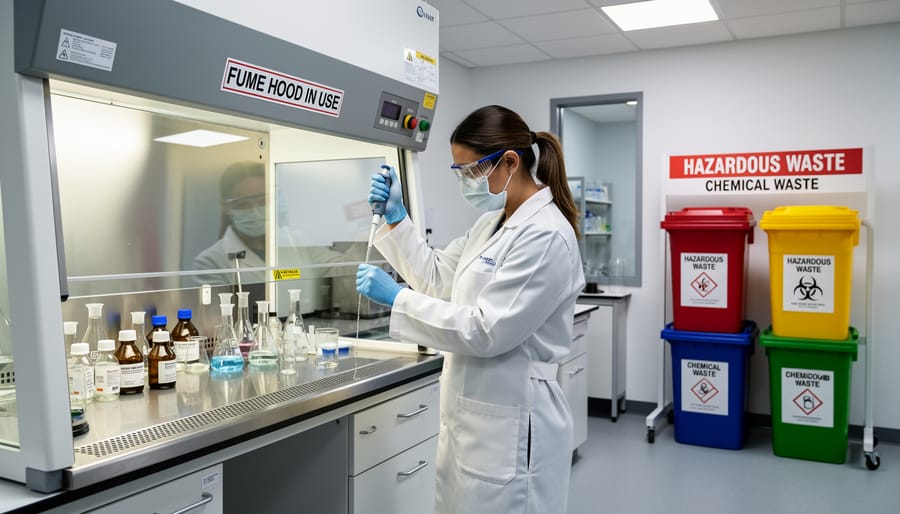
Every instrument in a purity workflow sits next to hazards that deserve respect, not fear. Before you touch a vial, read the safety data sheet for each reagent and confirm you’re authorized to run the instrument. Institutional protocols come first, and a trained operator should supervise anyone new to the equipment.
The chemical risks are familiar to both fields. Acid digestion, used to dissolve battery cathodes and catalysts for metals analysis, relies on strong, corrosive acids that call for a fume hood, proper gloves and eye protection. Organic solvents such as acetonitrile are flammable and toxic, so keep them away from ignition sources and store waste in labelled containers. Peptide chemists add trifluoroacetic acid to many mobile phases and cleavage steps. It’s volatile and causes serious burns, so handle it only in ventilation and never mix waste streams without checking compatibility.
Hardware brings its own concerns. Compressed gas cylinders for ICP-MS and elemental analysis must be chained upright and fitted with the correct regulators. Plasma torches, ovens and furnaces run at extreme temperatures, and mass spectrometers use high voltage, so never bypass interlocks or open covers on a running system. Battery materials need extra care: electrolytes can be reactive with moisture, and lithium compounds belong in the controlled conditions your facility specifies.
Work with hazardous reagents is never a solo job. Keep a colleague within earshot and know where the eyewash station and spill kit are.
Treat these stop conditions as a normal part of good practice. Pausing to investigate costs minutes, while pushing on can cost an instrument, a sample or someone’s health.
Step-by-Step: Running a Purity Check the Way Both Fields Do
Choosing the Right Instrument for the Question
Before you touch a vial, decide what question you’re asking, because each instrument answers a different one. Liquid chromatography (HPLC) separates a sample into its parts and tells you how much of the main compound is present, which makes it the workhorse for organic purity. Mass spectrometry (MS) tells you what a molecule is by its mass, so it confirms identity. ICP-MS or ICP-OES measures trace metals down to parts per billion, and Karl Fischer titration measures water, which quietly ruins both electrolytes and peptide stocks.
The mix shifts by field. A peptide batch leans on HPLC for percent purity and MS to confirm the sequence is the right one, with Karl Fischer or a gravimetric check for water content. A battery material such as a cathode powder or electrolyte leans on ICP for metal impurities like iron or copper, Karl Fischer because even small amounts of moisture react with lithium salts, and HPLC or ion chromatography for organic additives and decomposition products.
Whichever technique you pick, the working sequence is nearly identical:
- Define the purity question and write down the acceptance limit, such as 95% purity or under 10 ppm iron.
- Prepare clean glassware and set aside blanks.
- Prepare the sample and the certified reference standard in matching solvent.
- Calibrate the instrument with fresh calibration solutions.
- Run the blank first, then the standard, then your sample.
- Separate and detect the components in the run.
- Integrate the peaks or read the measured concentrations.
- Compare the result against your acceptance limit.
- Record the raw data and instrument conditions so someone else can repeat the work.
Matching the instrument to the question first keeps every later step focused.
Where the Two Workflows Diverge
The two workflows split first at sample preparation. A battery cathode is a solid, so a metals check usually starts with acid digestion for ICP-MS, which breaks the material down into a clear liquid the instrument can read. That step uses strong acids, heat and careful dilution, and the aim is to dissolve everything without adding contamination.
A peptide goes the opposite way. It is already an organic compound, so the goal is gentle dissolving in a solvent that matches the chromatography mobile phase, often a water and acetonitrile mix. Harsh treatment would destroy the very molecule you want to measure.
Acceptance criteria differ too. Battery work often cares about parts per million or even parts per billion of specific metals. Peptide chemists usually report a percent purity figure and check that impurities, such as truncated sequences, stay below a set limit. Same discipline, different finish line.
Verification and Next Steps: Confirming Your Results Are Trustworthy
A purity number only means something once you’ve shown the measurement itself can be trusted. Start with your blanks. A clean blank run before and after your samples should show no peaks or signal at the retention time or mass of interest. If it does, you’re measuring carryover or contamination, not your material.
Next, confirm system suitability. Inject a known standard and check that retention time, peak shape and response sit within the limits you set beforehand. Then look at calibration linearity: your standards should fall along a straight line across the working range, with your sample landing inside it, not beyond the top point.
Repeat the run at least in duplicate or triplicate. Tight agreement tells you the method is stable; scatter tells you something in preparation or the instrument is off. Where it matters, cross-check with a second technique. A peptide that looks 98 percent pure by liquid chromatography should show the expected mass by mass spectrometry, and a trace metal figure from ICP can be sanity-checked against a different digestion or an independent method. Finally, compare everything against a certified reference standard so your answer is anchored to something external.
When a result fails, resist the urge to simply rerun it. Re-prepare the sample from scratch to rule out a dilution or digestion error. If a ghost peak appears, run extra blanks to test for carryover, and clean the injection path or replace the wash solvent. Check that standards haven’t expired and that your solvents are fresh.
Once results hold up, make them repeatable. Write down the method in enough detail that a colleague could reproduce it, then validate it for accuracy, precision and detection limits. Teams without their own instruments don’t need to buy them. Many Canadian universities run core facilities open to outside users, and funding support, such as a federal clean energy program, can sometimes help cover access costs for clean technology projects.
Common Questions About Shared Purity Testing
Most of the questions below come up the first time a clean technology team and a peptide group end up booking the same instrument. The answers stay practical and assume you work to your own facility’s protocols.
Can one instrument really serve both clean tech and peptide work?
Yes. An HPLC or a mass spectrometer measures molecules, not industries, so the same hardware handles a battery electrolyte additive and a synthetic peptide. What changes is the method: columns, solvents, calibration standards and acceptance criteria are set for each sample type.
How often should I calibrate?
It depends on the instrument and your quality system, so follow your facility’s schedule. As a rule, run a calibration check or system suitability test at the start of every batch, and do a full recalibration whenever a check drifts or after maintenance.
How do I avoid cross-contamination between very different samples?
Run blanks between sample types and watch them for carryover before you trust any result. Many labs also dedicate columns, tubing or sample cones to one field. That is a simple guard against trace metals meeting a peptide run, or the reverse.
How can a small Canadian team get access to shared equipment?
Start with university core facilities, which often accept external users on a fee-for-service basis. Ask about operator training and booking rules, because most facilities expect trained users or will run the samples for you.
A fifth question trips up newcomers: what separates research-grade from regulated-grade testing? Research-grade work aims to answer a scientific question, so a documented, repeatable method is usually enough. Regulated-grade testing adds formal method validation, controlled documentation and audit trails, because the result may support a product release or a regulatory filing. If you expect your data to travel beyond the lab, build to the stricter standard early.
The same discipline matters wherever precision counts. It underpins the push toward green manufacturing, and it applies equally to work such as PT-141 research, where a trustworthy purity number depends on clean samples and honest controls.
A battery electrolyte and a synthetic peptide look nothing alike, yet the question behind both is the same: what exactly is in this sample, and what shouldn’t be? Chromatography, mass spectrometry, ICP-MS and elemental analysis answer that question in either field, and the discipline around them (clean blanks, fresh standards, repeat runs, a second technique to cross-check) is what makes the answer trustworthy.
That shared rigour is more than a technical convenience. Every cleaner battery, more efficient solar coating and carefully made therapeutic starts with someone confirming, honestly, that the material is what they think it is. Without that, innovation is guesswork.
Canada is well placed to build on this. University core facilities and shared-equipment models already put clean technology researchers and peptide chemists in the same room, learning from each other’s methods. As those collaborations grow, the labs that measure carefully, and share what they learn, will help shape a cleaner and more capable future.