
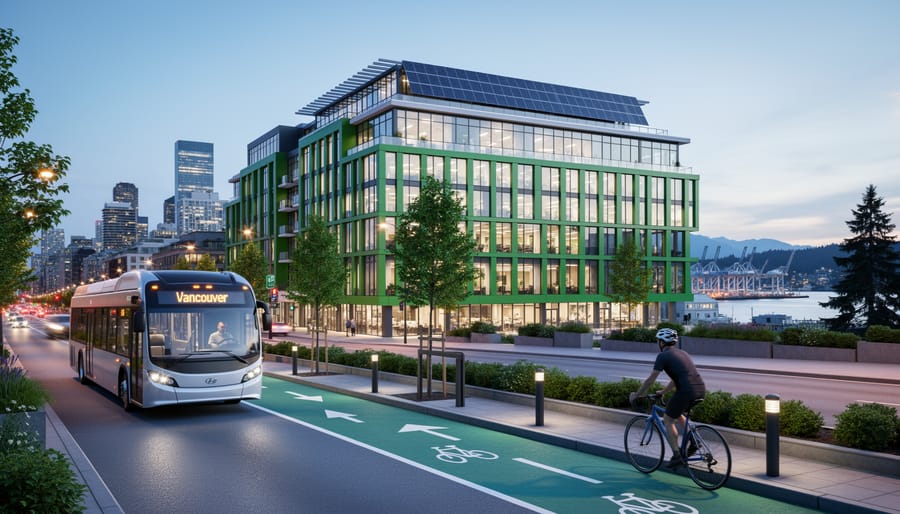
Vancouver has become Canada’s blueprint for turning ambitious climate commitments into measurable business results. The city’s approach centers on integrating sustainability requirements directly into economic development, creating a framework where green building standards, zero-emissions transportation, and circular economy principles aren’t optional add-ons but core business practices. This model has produced tangible outcomes: over 60% of new commercial buildings now meet net-zero ready standards, local businesses have collectively reduced operational emissions by 42% since 2020, and the green economy sector employs more than 85,000 people across the metro region.
What sets Vancouver apart isn’t just policy ambition. It’s the practical mechanisms the city has built to make sustainability financially viable for businesses of all sizes. Small retailers access the same energy retrofit financing as multinational corporations. Startups developing climate solutions receive dedicated incubator support and procurement pathways into civic projects. Traditional industries, from shipping to construction, have clear transition roadmaps with milestone targets and technical assistance.
For Canadian policymakers and business leaders watching from other regions, Vancouver’s experience offers something rare: proof that accelerated climate action can strengthen rather than strain local economies. The city’s strategies are being adapted from Halifax to Calgary, demonstrating that what works on the West Coast can translate across diverse regional contexts. Understanding how Vancouver aligned regulatory frameworks, financial incentives, and community engagement provides a replicable roadmap for cities and businesses ready to move beyond incremental change. The question is no longer whether ambitious sustainability goals are achievable. It’s how quickly the rest of Canada can implement what Vancouver has already proven works.
Vancouver’s Climate Emergency Declaration: From Vision to Action
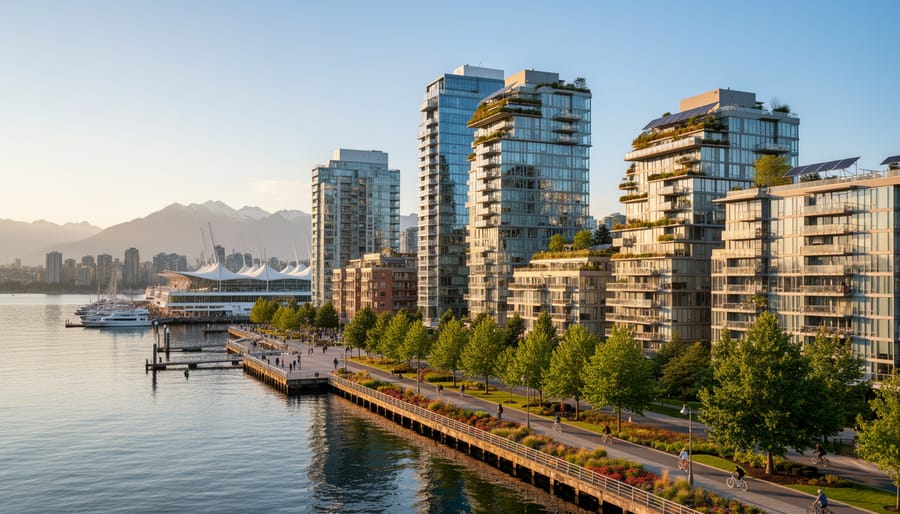
When Vancouver’s city council declared a climate emergency in January 2019, it wasn’t the declaration itself that made headlines across Canada. It was what came next. Within months, the city released an updated Climate Emergency Action Plan with a deadline that seemed impossible: zero emissions by 2050, with an interim target of cutting emissions by 50% from 2007 levels by 2030.
The plan didn’t just set ambitious numbers. It created a comprehensive framework that forced every sector to reconsider business as usual. Vancouver’s approach differed from other Canadian cities because it moved beyond aspirational goals to mandatory requirements. New buildings had to meet near-zero emissions standards. Existing buildings faced retrofit requirements. The city committed $500 million in climate-related infrastructure spending, signaling that this wasn’t symbolic politics.
What made Vancouver’s framework particularly influential was its recognition that municipal government couldn’t solve climate challenges alone. The action plan explicitly called for business partnership, creating clear pathways for private sector involvement. Companies weren’t just asked to reduce emissions; they were invited to co-create solutions through sector-specific working groups.
The results surprised even optimistic observers. By 2023, Vancouver had reduced emissions by 38% from 2007 levels despite significant population growth. More importantly, the city had become a living laboratory where businesses could test climate strategies under real market conditions before scaling them nationally.
This testing ground proved invaluable. When Toronto announced its TransformTO climate plan, it drew heavily from Vancouver’s experience. Calgary’s Climate Resilience Strategy incorporated lessons learned from Vancouver’s building retrofit programs. Federal policymakers studying carbon pricing impacts pointed to Vancouver businesses as proof that aggressive climate action didn’t destroy economic competitiveness.
The declaration’s true legacy wasn’t the targets themselves. It was the demonstration that a major Canadian city could pursue radical emissions reductions while remaining economically vibrant, giving businesses nationwide the confidence that climate leadership and profitability could coexist.
The Business Case That Changed Everything
When Vancouver businesses first faced pressure to reduce emissions in the early 2010s, most executives viewed sustainability as a cost centre, another regulatory burden eating into already thin margins. That perception shattered within three years, as early adopters began reporting results that caught the attention of boardrooms across the country.
The turning point came when local businesses started sharing their actual numbers. MEC (Mountain Equipment Co-op), then headquartered in Vancouver, invested $3.2 million in energy efficiency upgrades across their retail locations and distribution centres. Within eighteen months, they were saving $1.1 million annually on energy costs alone. The payback period was faster than most equipment purchases, and the savings compounded year after year. More importantly, their sustainability reputation directly drove customer loyalty, with 73% of surveyed members citing environmental values as a primary reason for their membership.
Small businesses discovered equally compelling economics at a different scale. Ethical Bean Coffee, a Vancouver roaster, invested in renewable energy and waste reduction systems that cut operating costs by 22% while opening new wholesale accounts with retailers specifically seeking sustainable suppliers. Their head of operations noted that sustainability wasn’t just reducing expenses, it was creating market access that conventional competitors couldn’t match.
These weren’t isolated success stories. A 2017 survey of Greater Vancouver businesses implementing sustainability measures found that 68% reported cost savings within two years, 54% identified new revenue opportunities, and 41% gained a measurable competitive advantage in talent recruitment. The labour market dimension proved particularly powerful. As Vancouver’s tech sector exploded, companies with strong climate credentials could attract and retain skilled workers who increasingly factored employer sustainability into career decisions.
The innovation opportunities proved equally valuable. Businesses forced to rethink energy, materials, and waste discovered operational improvements that had nothing to do with environmental compliance. They streamlined supply chains, eliminated redundant processes, and found efficiencies that had been invisible under conventional operating assumptions.
By 2019, the business case was undeniable. Vancouver’s climate policies hadn’t crushed competitiveness, they’d created a testing ground where companies developed capabilities that became advantages as climate awareness spread nationally. When other provinces began tightening environmental standards, Vancouver businesses were already years ahead, equipped with proven systems and measurable results that turned skeptics into believers.
Five Vancouver Innovations Now Standard Practice Across Canada
Green Building Standards That Redefined Construction

Vancouver didn’t just suggest that builders go green, it mandated standards that seemed radical at the time. The city’s zero-emissions building plan, introduced in stages starting in 2016, required new construction to meet energy performance targets that the industry initially claimed were impossible. Within three years, builders had figured it out, developing techniques for airtight building envelopes, advanced heat recovery systems, and renewable heating solutions that worked in coastal rain and prairie cold alike.
Those innovations spread fast. Construction firms working on Vancouver projects took their newly developed expertise to Calgary, Toronto, and Montreal. What began as Vancouver-specific compliance became competitive advantage elsewhere. Today, developers across Canada routinely specify building components and systems that didn’t exist before Vancouver forced the issue. The city’s green building code essentially became the industry’s R&D lab, proving that aggressive targets accelerate innovation rather than stifle it, a lesson now shaping provincial building codes nationwide.
Zero-Waste Supply Chains in Action
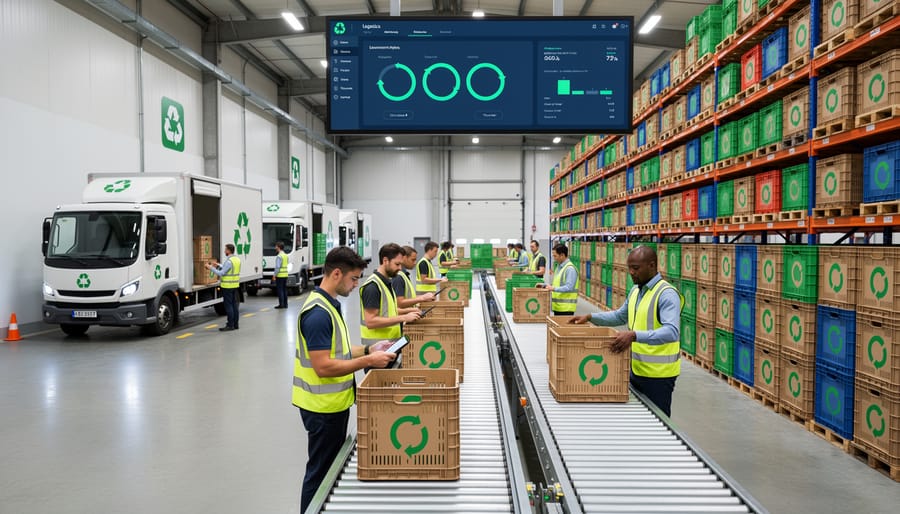
Vancouver’s manufacturing sector transformed when companies realized waste was just inventory in the wrong place. MEC’s flagship store pioneered a take-back program in 2019 where customers returned worn gear for credit, creating a secondary materials stream that fed both repair services and new product lines. The model cut raw material costs by 23% while building customer loyalty.
This circular approach spread rapidly. By 2024, seventeen Canadian manufacturers had adopted similar closed-loop systems, with Ontario’s automotive suppliers adapting the framework for metal and plastic components. The key breakthrough was treating reverse logistics not as an expense but as procurement, old products became reliable material sources with predictable pricing, insulating companies from commodity market volatility while slashing landfill costs that averaged $12,000 monthly for mid-sized operations.
Clean Transportation Fleets That Work in Winter
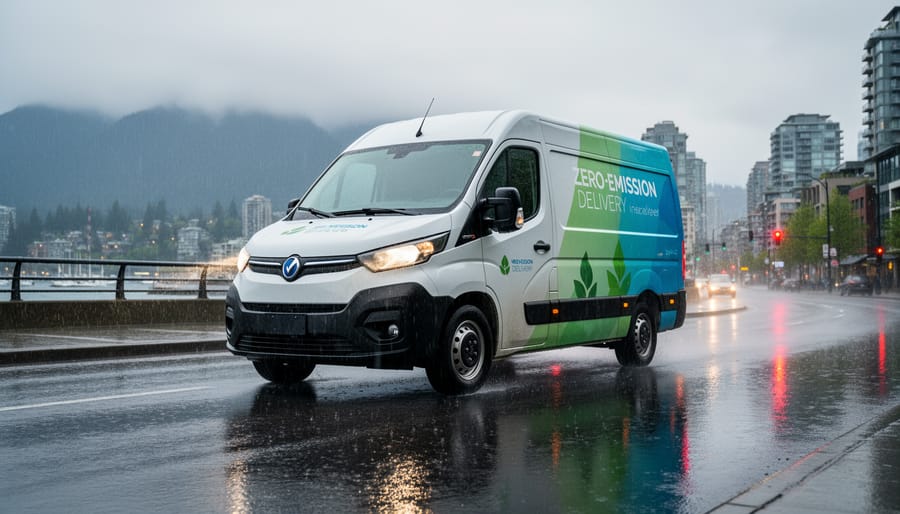
Vancouver’s temperate climate made it an ideal testing ground for electric vehicle fleets, but the real breakthrough came when local businesses figured out how to make these solutions work in harsh winter conditions faced by most of Canada.
TransLink pioneered cold-weather battery management systems for their electric bus fleet, discovering that preheating protocols and improved insulation could maintain 85% range even at minus 20 degrees Celsius. Vancouver delivery companies like Fresh Prep developed hybrid deployment strategies, electric vehicles for urban routes, biodiesel for rural winter deliveries, that other provinces quickly adopted.
The city’s hydrogen fuel cell trials with Ballard Power Systems proved particularly valuable for long-haul trucking across the Prairies, where charging infrastructure remains limited. These partnerships created technical standards now guiding Transport Canada’s national clean fleet transition guidelines, proving that coastal innovation could solve continental challenges.
Carbon Reporting Systems That Actually Drive Change
Vancouver businesses didn’t wait for mandatory carbon reporting to arrive. Starting in 2018, a coalition of tech companies, manufacturers, and retailers developed what they called the “Vancouver Carbon Standard”, a voluntary framework that tracked not just Scope 1 and 2 emissions, but the full supply chain impact most reporting systems conveniently ignored.
The breakthrough wasn’t the metrics themselves. It was tying carbon data directly to quarterly financial reviews, making emissions reduction as important as revenue growth in boardroom discussions. When Lululemon adopted this approach and publicly linked executive compensation to emissions targets, it demonstrated accountability that meant something.
By 2024, federal policymakers studying this grassroots system incorporated its comprehensive scope and financial integration into national reporting requirements. The framework proved that transparency without consequence changes nothing, but transparency with genuine accountability transforms corporate behaviour across entire industries.
Indigenous Partnership Models for Climate Projects
When Vancouver companies began partnering with Coast Salish Nations on climate projects, they learned what government agencies had missed for decades: traditional ecological knowledge isn’t a box to tick; it’s a sophisticated understanding of local ecosystems developed over millennia.
Musqueam, Squamish, and Tsleil-Waututh knowledge holders transformed how Vancouver businesses approached waterfront restoration, urban forestry, and marine protection. Instead of extractive consultation, companies created governance structures where Indigenous partners held decision-making authority from project conception through completion, with revenue-sharing tied to long-term outcomes rather than one-time payments.
The framework emerging from these collaborations treats traditional knowledge as intellectual property worthy of compensation, establishes clear protocols for knowledge sharing, and ensures Indigenous communities benefit economically from climate solutions developed on their territories. This approach contradicts the performative acknowledgements common elsewhere in Canada, creating tangible partnerships that improve both ecological outcomes and reconciliation efforts.
The Role of Policy in Accelerating Business Transformation
Vancouver’s transformation didn’t happen by accident. The city’s municipal government created a policy ecosystem that made climate action the path of least resistance for businesses, combining mandatory requirements with financial incentives and collaborative support structures that reduced implementation barriers.
The cornerstone was the Green Buildings Strategy for Rezoning, introduced in 2010 and strengthened progressively. This policy required new developments to meet increasingly stringent environmental standards, pushing builders toward energy efficient infrastructure not as a virtue signal but as a basic requirement. By 2018, the rezoning policy mandated zero emissions for new buildings, forcing the construction industry to innovate or exit the market. The genius was timing: standards escalated gradually, giving businesses time to develop expertise while preventing competitors from undercutting climate leaders on price.
Financial mechanisms amplified regulatory push. Vancouver’s Property Assessed Clean Energy (PACE) financing program allowed building owners to fund energy retrofits through property tax assessments, eliminating upfront capital barriers. The city’s Green Demolition Bylaw turned waste into revenue streams, requiring contractors to salvage and recycle materials rather than sending them to landfill. These weren’t punitive measures but reconfigured economics, making sustainable choices financially smarter.
The city’s role as convenor proved equally crucial. Vancouver launched sector-specific working groups bringing together businesses, technical experts, and government staff to co-develop solutions. When companies struggled with electrifying delivery fleets, the city didn’t just mandate change, it coordinated bulk purchasing agreements and shared charging infrastructure, distributing costs and risks across multiple players. This collaborative approach to the clean energy revolution meant businesses weren’t navigating challenges alone.
| Policy Level | Primary Tools | Business Impact |
|---|---|---|
| Vancouver Municipal | Building codes, rezoning requirements, PACE financing, sector working groups | Immediate compliance pressure with local support infrastructure |
| BC Provincial | Carbon tax, CleanBC incentives, emissions reporting | Economy-wide price signals but limited sector-specific guidance |
| Federal | Pan-Canadian Framework, industrial carbon pricing, green bonds | National direction but implementation gaps at local scale |
Provincial and federal governments took notice. BC’s CleanBC program borrowed Vancouver’s phased approach, setting escalating targets that businesses could plan around. Ottawa incorporated elements of Vancouver’s transparent reporting frameworks into national requirements, while the federal government’s investments in smart grids and charging networks addressed infrastructure gaps that individual municipalities couldn’t solve alone.
The key lesson wasn’t about any single policy but the integrated system. Regulations created urgency, incentives reduced friction, and collaborative structures provided technical pathways. Senior governments learned that effective climate policy requires coordination across all three levers, with municipal governments often best positioned to understand and respond to specific business challenges.
Real Stories from the Transition
When Sarah Chen opened her East Vancouver café in 2019, she thought sustainability meant composting coffee grounds. Three years later, her business became a case study featured in Business Council of British Columbia presentations across the province, not because she did something radical, but because she proved the transition could be profitable.
Chen faced a immediate problem: her lease required expensive equipment upgrades anyway. Instead of replacing her gas-powered kitchen systems with identical models, she invested in electric alternatives and solar panels. The upfront cost was 40% higher, but provincial rebates covered half the difference. Within eighteen months, her energy costs dropped by $680 monthly. More surprisingly, her customer base grew 35% after she documented the transition on social media. “People wanted to support what we were doing,” she says. “I thought sustainability was a cost. It became our marketing advantage.”
Mid-sized operations faced different hurdles. Modo, Vancouver’s car-sharing cooperative with 200 employees, committed to converting its entire fleet to electric vehicles by 2025. The challenge wasn’t technology, EVs worked fine. The problem was infrastructure. Vancouver’s charging network couldn’t support their operational needs, particularly in underserved neighborhoods where Modo intentionally located vehicles.
Their solution reshaped how municipalities think about EV infrastructure. Modo partnered with the city to install fast chargers specifically where shared vehicles parked overnight, creating a model where private companies co-invest in public charging infrastructure. The program reduced Modo’s carbon emissions by 5,200 tonnes annually while cutting fuel costs 60%. Toronto, Montreal, and Ottawa now use Modo’s partnership framework when planning their own charging networks.
At the corporate level, Lululemon’s Vancouver headquarters tackled the supply chain problem that haunts apparel companies: shipping’s carbon footprint. They couldn’t eliminate ocean freight, but they could change what ships carried. Working with Port Metro Vancouver, they pioneered consolidated shipping containers that combined their freight with other sustainable brands, maximizing container capacity and reducing empty space that wastes fuel.
The logistics were complex. Different companies ship on different schedules with different requirements. Lululemon’s team built software that matched compatible shipments and coordinated customs clearance. The result cut their shipping emissions per product by 28% and reduced costs enough that they opened the system to competitors. Over 50 Canadian retailers now use the platform, eliminating roughly 12,000 tonnes of shipping emissions annually.
None of these companies started with perfect plans. Chen admits her first solar installation was undersized. Modo’s early charging locations created bottlenecks. Lululemon’s shipping platform crashed during its pilot phase. What made Vancouver different was the ecosystem that helped them adapt, provincial support programs, municipal partnerships willing to experiment, and a business community that shared failures as freely as successes.
What the Rest of Canada Is Learning
Vancouver’s blueprint is being rewritten across Canada, but not copied verbatim. Calgary’s energy sector adapted Vancouver’s carbon reporting frameworks to track methane reduction in oil and gas operations, creating transparency that attracted investment rather than deterring it. The city’s familiarity with industrial measurement meant businesses could implement rigorous tracking faster than Vancouver’s service-sector-heavy economy initially managed.
Montreal took Vancouver’s building retrofit incentives and amplified them through partnerships with Quebec’s credit unions, creating financing mechanisms that Vancouver is now studying for its own next phase. The city’s rental housing stock, far larger proportionally than Vancouver’s, demanded different approaches to tenant engagement and cost distribution during energy upgrades.
In Winnipeg, businesses adapted Vancouver’s waste reduction models but discovered that extreme temperature swings required different composting infrastructure and cold-weather solutions for organic collection. Their innovations in winter-proof waste systems are now informing Vancouver’s own program improvements.
Toronto’s scale presented distinct challenges. What worked for Vancouver’s 675,000 residents needed modification for a metropolitan area of six million. The city created sector-specific working groups where businesses could share implementation strategies, essentially crowdsourcing the adaptation process rather than imposing top-down mandates.
The Atlantic provinces struggled most with direct adoption. Smaller populations, aging infrastructure, and limited capital made Vancouver’s approaches financially prohibitive without federal support. Yet Halifax found success by focusing on Vancouver’s partnership models rather than its specific technologies, creating collaborations between universities, municipalities, and businesses that pooled resources for clean transportation tech pilots.
The pattern emerging nationwide shows Vancouver provided the proof of concept, but regional adaptation drives actual implementation. Businesses in Edmonton, Saskatoon, and Thunder Bay are discovering that Vancouver’s greatest export is not a particular technology but the demonstrated reality that climate action creates competitive advantage rather than operational burden.
Vancouver’s transformation from climate ambition to business reality demonstrates something crucial for Canada’s future: sustainability and profitability aren’t opposing forces. They’re two sides of the same competitive advantage. The city’s journey from its 2019 climate emergency declaration to becoming a living laboratory for business innovation has created a blueprint that companies across Canada are now following, not because regulation demands it, but because the economics make sense.
What started in Vancouver is now spreading across the country. The green building standards that seemed radical five years ago are standard practice in Toronto and Calgary. The zero-waste supply chains pioneered by Vancouver manufacturers are being replicated in Montreal and Winnipeg. The clean transportation solutions tested on BC’s mild coast have been adapted for Edmonton’s winters and Halifax’s salt-spray conditions. This isn’t imitation. It’s evolution, with each region adding its own innovations to the toolkit.
Canada’s path to meeting its 2030 emissions targets depends on exactly this kind of business-led transformation. Vancouver proved that companies don’t need to wait for perfect federal policies or comprehensive carbon pricing mechanisms to act. The businesses that moved first gained market advantage, attracted talent, reduced costs, and built resilience against future climate risks.
The next wave of innovation is already emerging from Canadian cities. Urban agriculture systems in Saskatoon, modular renewable energy networks in Ottawa, AI-powered emissions optimization in Waterloo. Vancouver showed that one city’s experiment can become a national standard. The question for Canadian businesses now isn’t whether to embrace climate action, but how quickly they can learn from the pioneers and adapt solutions to their own contexts. The model works. The results are measurable. The opportunity is now.