
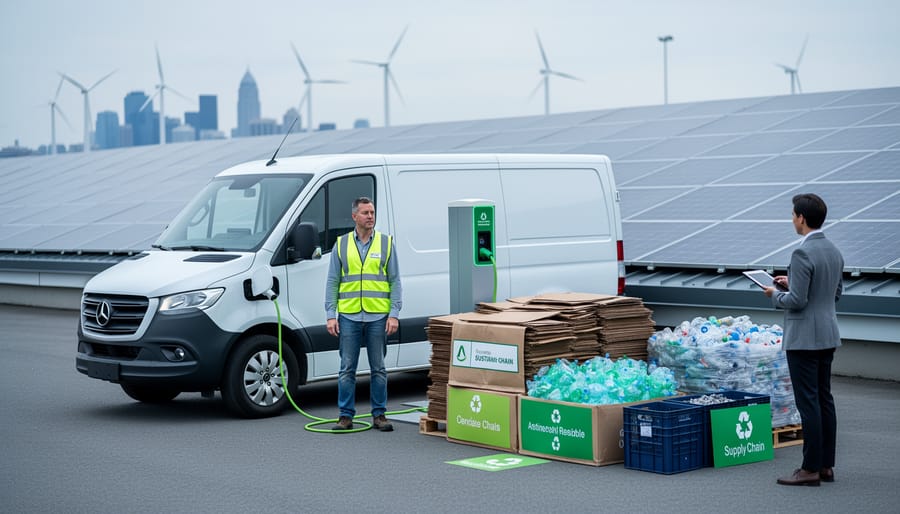
Canadian businesses are reshaping their operations to meet ambitious climate goals, driven by a combination of federal net-zero targets, investor pressure, and the recognition that sustainable practices can unlock competitive advantages in a rapidly changing global economy. From multinational corporations pledging science-based emissions reductions to small enterprises adopting circular business models, the private sector has become a crucial player in Canada’s climate strategy. Yet progress remains uneven, with significant gaps between stated commitments and measurable outcomes.
The landscape in 2026 reflects both encouraging momentum and stubborn challenges. Companies across sectors are investing in renewable energy procurement, electrifying fleets, and overhauling supply chains to reduce carbon footprints. Financial institutions are integrating climate risk into lending decisions. Technology firms are developing tools that make emissions tracking accessible to businesses of any size. Indigenous-led enterprises are demonstrating how traditional ecological knowledge can inform modern sustainability practices, offering models that connect environmental stewardship with economic opportunity.
But the journey is far from straightforward. Many businesses struggle with the upfront costs of transitioning away from fossil fuels, the complexity of verifying supply chain emissions, and the absence of uniform standards for measuring progress. Greenwashing remains a concern, as some firms amplify modest efforts while their core operations remain unchanged. Small and medium-sized businesses, which represent the vast majority of Canadian employers, often lack the resources and expertise to navigate the transition without targeted support.
Understanding how Canadian businesses are responding to climate imperatives requires looking beyond corporate pledges to examine what’s actually working on the ground, who’s leading the way, and where the most significant barriers persist. The answers reveal an economy in transition, with early successes lighting the path forward and persistent obstacles demanding innovation, collaboration, and accountability.
The Business Case for Climate Action in Canada
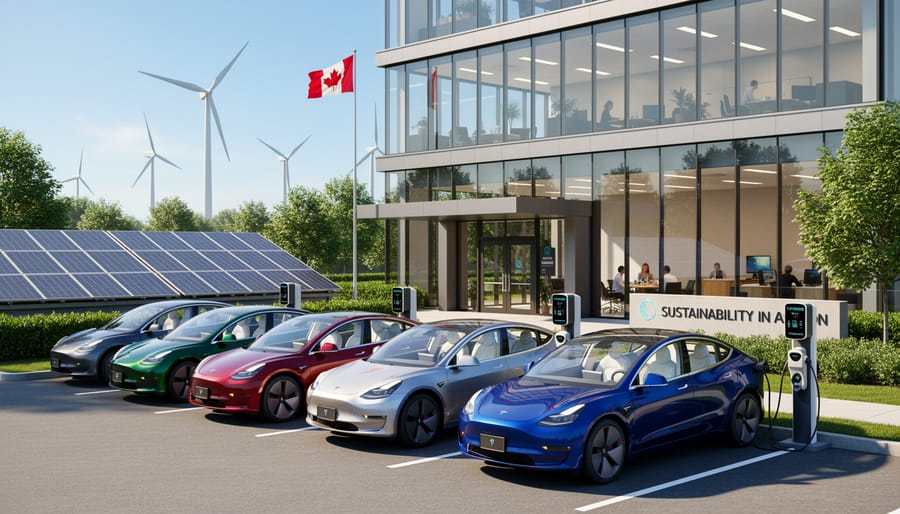
Canadian businesses are discovering that climate action isn’t just about meeting regulatory requirements, it’s about securing their future in a rapidly changing marketplace. The shift from viewing sustainability as a compliance burden to recognizing it as a strategic advantage marks one of the most significant business transformations of this decade.
Market forces are driving much of this change. Consumers increasingly favor companies with credible environmental commitments, and corporate buyers are scrutinizing their supply chains for climate risks. A 2025 survey found that 73% of Canadian consumers consider a company’s environmental practices when making purchasing decisions, up from 58% just three years earlier. This isn’t abstract virtue signaling, it translates directly into market share and customer loyalty.
Investor pressure has intensified dramatically. Institutional investors managing trillions in assets now routinely assess climate risk alongside traditional financial metrics. Companies that can’t articulate clear decarbonization strategies face higher capital costs or find themselves excluded from major investment portfolios. Canadian pension funds, which collectively manage over $2 trillion, have become particularly vocal about climate disclosure and action, using their considerable influence to push for substantive change.
The talent war adds another dimension. Young professionals want to work for organizations aligned with their values, and climate commitment ranks high on that list. Companies with strong environmental track records report better recruitment outcomes and higher employee retention. It’s not just idealism, people recognize that climate-forward companies tend to be more innovative and better positioned for long-term success.
Long-term resilience may be the most compelling reason. Climate change brings physical risks (extreme weather, resource scarcity) and transition risks (policy shifts, technology disruption, stranded assets). Businesses investing in energy-efficient infrastructure renewable energy, and low-carbon operations are building resilience against both. They’re reducing exposure to volatile fossil fuel prices, anticipating regulatory changes rather than reacting to them, and positioning themselves for emerging opportunities in the clean economy.
What once seemed like a cost center now looks like competitive differentiation. The question for Canadian businesses isn’t whether to pursue climate goals, but how quickly they can move.
Canada’s Climate Targets: What Businesses Need to Know
Canada’s commitment to reaching net-zero emissions by 2050 sets the overarching framework that increasingly shapes how businesses operate, invest, and plan for the future. Canada’s net-zero 2050 plan isn’t just an environmental aspiration, it translates into concrete interim targets that create both obligations and opportunities for companies across every sector. The country aims to cut emissions 40 to 45 percent below 2005 levels by 2030, a milestone that requires significant action within this decade.
For businesses, these national goals cascade into a mix of regulations, incentives, and market expectations. Federal carbon pricing continues to rise incrementally, making emissions more expensive and rewarding efficiency. Sector-specific regulations are tightening for energy, transportation, and heavy industry, while voluntary disclosure frameworks are becoming standard practice as investors and consumers demand transparency on climate performance.
Several key policies and frameworks now shape corporate climate strategies in Canada:
- The federal carbon pricing system, which applies across provinces and increases annually to incentivize emissions reductions
- Clean Fuel Regulations requiring lower carbon intensity in gasoline and diesel
- Emissions caps for the oil and gas sector, setting hard limits on production-related emissions
- The Greenhouse Gas Pollution Pricing Act, establishing the legal foundation for carbon pricing
- Net-Zero Emissions Accountability Act, mandating five-year emissions reduction milestones and requiring government accountability
Domestic climate policy assumptions built into federal energy projections show how policymakers expect these frameworks to drive business behaviour and technology adoption through 2050. Understanding these timelines helps companies anticipate regulatory shifts rather than react to them.
The practical reality is that climate targets influence everything from capital allocation to supply chain decisions. Companies that align their strategies with Canada’s trajectory position themselves to access green financing, meet procurement requirements, and attract climate-conscious talent and customers. Those that delay face mounting compliance costs and reputational risks as the gap between ambition and action narrows.
Industries Leading Canada’s Climate Transition
Energy Sector: From Fossil Fuels to Clean Power
Canada’s energy sector is undergoing a fundamental transformation as companies that built their foundations on fossil fuels now race to secure their place in a low-carbon future. Major players like Suncor Energy and TC Energy are channeling billions into renewable projects, from wind farms in Alberta to hydrogen production facilities, while simultaneously pursuing carbon capture technology to reduce emissions from existing operations. This dual strategy reflects the reality that transition happens incrementally, not overnight.
Meanwhile, a new generation of clean energy innovators is reshaping what Canada’s energy landscape looks like. Vancouver-based Carbon Engineering has developed direct air capture technology that pulls CO2 from the atmosphere, while companies like Eavor Technologies are pioneering closed-loop geothermal systems that generate baseload power without fracking or water consumption. These startups aren’t just filling gaps left by traditional players; they’re creating entirely new markets and proving that Canadian ingenuity extends well beyond resource extraction. The contrast is stark: where legacy companies measure progress in percentage reductions, these newcomers are building systems designed carbon-neutral from day one, attracting both venture capital and partnerships with established energy giants seeking credibility in the transition.
Manufacturing and Heavy Industry: Decarbonizing Production

Canada’s heavy industry and manufacturing sectors, historically carbon-intensive pillars of the economy, are transforming how they produce goods. Steel mills in Hamilton are piloting hydrogen-based direct reduction furnaces to replace coal-fired smelting. Cement producers across Quebec and Ontario are incorporating carbon capture systems and alternative fuels, cutting emissions by up to 30% per tonne. Auto parts manufacturers in southwestern Ontario have electrified assembly lines and switched to renewable electricity, reducing operational carbon by nearly half since 2020.
The circular economy is gaining traction beyond recycling slogans. Aluminum smelters in British Columbia now source 95% recycled content for certain product lines, slashing energy use compared to virgin production. Packaging manufacturers are redesigning products for disassembly and reuse, keeping materials in production cycles longer. Pulp and paper mills are converting waste biomass into biogas that powers operations, closing loops that once sent emissions skyward.
Electrification extends to industrial heat, a stubborn emissions source. Ontario food processors are replacing natural gas boilers with electric heat pumps and thermal storage. Mining operations in northern regions are testing battery-electric haul trucks and renewable microgrids. Even sectors building efficient buildings increasingly rely on low-carbon steel and concrete, creating demand that pushes suppliers toward cleaner production.
These shifts require capital, retrofitting a cement kiln costs millions, but manufacturers report competitive gains: lower energy costs, new market access, and resilience against carbon pricing.
Financial Services: Green Investing and Climate Risk
Canada’s financial sector is embedding climate considerations into its core operations, fundamentally reshaping how capital flows through the economy. Major banks now screen commercial loans for climate risk alongside traditional credit metrics, while insurers are recalibrating premiums and coverage based on physical climate exposures like flooding and wildfire. This shift reflects both regulatory expectation and market reality: the OSFI climate risk management guidance requires federally regulated financial institutions to identify, measure, and manage climate-related risks as material financial exposures.
Investment firms are directing unprecedented capital toward sustainable ventures. Green bonds, ESG-screened portfolios, and climate-focused funds have moved from niche offerings to mainstream products. Pension funds managing billions in Canadian retirement savings now set portfolio decarbonization targets and actively engage with companies on climate performance. Some institutions have stopped financing new fossil fuel projects entirely, while others apply carbon pricing to investment decisions.
The competitive advantage is clear: financial institutions demonstrating climate leadership attract environmentally conscious clients, reduce exposure to stranded assets, and position themselves ahead of tightening regulations. They’re not just managing risk, they’re actively financing Canada’s transition by making clean energy projects, retrofit programs, and sustainable infrastructure financially viable.
Technology and Clean Tech: Innovation as Climate Solution
Canada’s clean technology sector has emerged as a powerful engine for climate solutions, with companies across the country turning environmental challenges into commercial opportunities. These innovators are developing technologies that help other businesses reduce emissions while creating significant economic value.
Carbon capture stands out as a critical frontier. Companies like Carbon Upcycling Technologies in Calgary transform captured CO2 into products for construction materials, turning waste into revenue. Meanwhile, CarbonCure injects recycled carbon dioxide into concrete during mixing, permanently storing it while improving the material’s strength, a technology now used in thousands of projects across North America.
In sustainable agriculture, firms such as Terramera are using artificial intelligence to develop natural pest control solutions that reduce chemical use by up to 80 percent, helping farms lower their environmental footprint without sacrificing yields. Precision agriculture platforms enable farmers to optimize inputs, cutting both costs and emissions.
Green building materials represent another growth area. Nexii Building Solutions manufactures low-carbon structural panels that reduce construction emissions by up to 70 percent compared to traditional methods, demonstrating that climate solutions can outperform conventional alternatives on multiple metrics. These technologies prove that Canadian innovation can address global climate needs while building competitive, scalable businesses.
Real Stories: Canadian Businesses Making Climate Progress
Canada’s climate leaders aren’t just talking about sustainability, they’re embedding it into their operations and reaping tangible rewards. These stories reveal how businesses of all sizes are turning climate commitments into measurable progress.
Hydro-Québec’s hydrogen ambitionThe provincial utility, already a hydroelectric giant, launched a pilot project in 2024 converting surplus renewable electricity into green hydrogen for industrial customers. Within eighteen months, three manufacturing partners replaced fossil fuel-based heating systems with hydrogen alternatives, cutting their combined emissions by 12,000 tonnes annually. The program faced early skepticism about infrastructure costs, but Hydro-Québec’s phased approach, starting with a single production facility and expanding based on demand, proved the model’s scalability. By early 2026, the waiting list for hydrogen access included seventeen additional companies.
Loblaws, Canada’s largest grocer, committed to halving food waste across its 2,400 stores by 2025. The company installed AI-powered inventory systems that predict demand patterns, reducing overordering of perishables. Unsold but edible food gets redirected through partnerships with Second Harvest and local food banks. The results exceeded targets: food waste dropped 54 percent by December 2025, saving approximately $2 million monthly while diverting 26,000 tonnes from landfills. Employees reported higher job satisfaction, citing pride in reducing waste they’d long viewed as inevitable.
Atlantic Sea Farmsa small Saco, Maine-based kelp farming operation with expanding Canadian waters partnerships, exemplifies climate-positive agriculture. Kelp absorbs carbon dioxide as it grows, requires zero fertilizer or freshwater, and provides raw material for food products and bioplastics. The company partnered with New Brunswick fishers transitioning from declining cod fisheries, training them in kelp cultivation techniques. Within three growing seasons, participating fishers generated 30 percent of their income from kelp harvests while contributing to ocean health. One fisher noted that kelp lines installed near traditional fishing grounds created habitat that attracted more marine life, an unexpected ecological benefit.
BrainBox AI, a Montreal artificial intelligence firm, developed technology that optimizes building heating and cooling systems in real time, reducing energy consumption without sacrificing comfort. Their algorithms learn building patterns and adjust HVAC operations predictively. Deployed across 400 commercial buildings by mid-2026, the system achieved average energy reductions of 25 percent and cut combined emissions by 68,000 tonnes. The company’s growth accelerated after early clients reported two-year payback periods on installation costs through energy savings alone, proof that climate solutions can deliver immediate financial returns alongside environmental benefits.
Indigenous Leadership in Business and Climate

Indigenous communities in Canada are reshaping the business approach to climate action by integrating traditional ecological knowledge with modern enterprise. Their leadership demonstrates that effective climate solutions require both innovation and deep respect for long-standing relationships with the land.
Companies like Lumos Energy, an Indigenous-owned clean energy developer, are building solar and wind projects on First Nations territories while ensuring communities share in ownership and decision-making. This model contrasts sharply with conventional energy development by prioritizing community consent, environmental stewardship, and lasting economic benefits rather than extraction and departure.
Traditional knowledge systems offer insights that Western science is increasingly recognizing as essential. Indigenous land management practices, including controlled burns and watershed protection, have sustained ecosystems for millennia. When Coastal First Nations in British Columbia partnered with conservation organizations to establish marine protected areas, they combined ancestral stewardship practices with contemporary conservation science, creating management approaches that protect biodiversity while supporting sustainable fisheries.
The financial sector is starting to acknowledge this expertise. Some Canadian banks now require Free, Prior and Informed Consent protocols when financing projects affecting Indigenous lands, moving beyond minimal consultation toward genuine partnership. Indigenous-led initiatives like the Indigenous Clean Energy Social Enterprise are training community members in renewable energy skills while developing projects that align with cultural values.
Yet true inclusion remains incomplete. Many corporate sustainability strategies still treat Indigenous perspectives as an afterthought rather than foundational. Companies serious about climate leadership are learning that meaningful collaboration means shared governance, equitable benefit distribution, and recognition that Indigenous peoples are not stakeholders to be managed but rights holders and knowledge keepers essential to Canada’s climate future.
Challenges Canadian Businesses Face in Meeting Climate Goals
Canadian businesses pursuing climate goals encounter substantial hurdles that can slow progress even when ambition runs high. Understanding these challenges helps contextualize the achievements covered earlier and highlights where additional support and innovation are needed.
Capital intensity stands as perhaps the most immediate barrier. Transitioning to low-carbon operations often requires significant upfront investment, retrofitting facilities, upgrading equipment, or adopting new technologies, with payback periods that can extend years into the future. Small and medium-sized enterprises face particular difficulty accessing the capital needed for climate projects, especially when competing priorities demand limited resources. Traditional financing models don’t always account for the long-term value of emissions reductions, leaving businesses to shoulder risk that hasn’t yet been fully priced into market returns.
Technological readiness varies dramatically across sectors. While solar panels and electric vehicles have become mainstream, many industries still lack proven, scalable solutions for deep decarbonization. Heavy manufacturing, long-haul transportation, and certain resource extraction activities have few commercially viable alternatives to carbon-intensive processes. Businesses in these sectors must either wait for technologies to mature or invest heavily in experimental approaches with uncertain outcomes.
Supply chain complexity creates another layer of difficulty. A company can overhaul its own operations yet remain dependent on suppliers who haven’t made similar commitments. Tracing emissions through multi-tier supply chains proves difficult and expensive, particularly for businesses sourcing globally. Requiring climate standards from suppliers can also strain relationships or increase costs in the short term.
Regulatory uncertainty complicates long-term planning. While Canada has established net-zero targets, the specific pathways, carbon pricing trajectories, and sector-by-sector requirements continue to evolve. Businesses making major capital decisions need policy clarity that sometimes arrives too slowly or changes unexpectedly, creating hesitation around irreversible investments.
Finally, regional disparities mean businesses face vastly different contexts depending on location. Alberta companies navigate different energy realities than Quebec firms. Access to renewable electricity, skilled labour, and climate-focused partnerships varies significantly across provinces, creating uneven playing fields that challenge national consistency in climate action.
Resources and Support for Business Climate Action
Canadian businesses don’t have to navigate the climate transition alone. A robust ecosystem of federal and provincial programs, industry partnerships, and advisory services exists to support companies at every stage of their sustainability journey.
The federal government offers multiple funding streams designed to accelerate climate action. Natural Resources Canada’s Clean Growth Program provides grants and contributions for projects that reduce greenhouse gas emissions and advance clean technology. Innovation, Solutions and Stratégie Canada (formerly Innovation, Science and Economic Development Canada) administers the Strategic Innovation Fund, which co-invests in large-scale transformational projects that include clean technology components. Export Development Canada has expanded its financing for companies pursuing low-carbon exports and sustainable business practices.
Provincial programs add another layer of support. British Columbia’s CleanBC Industry Fund helps large industrial operations reduce emissions. Ontario’s Emissions Performance Standards program includes compliance flexibility mechanisms. Quebec’s TECQ program supports technological innovation for emissions reduction. Alberta’s Technology Innovation and Emissions Reduction fund invests in clean technology development.
| Resource | Focus Area | Best Suited For |
|---|---|---|
| Clean Growth Program | Emissions reduction projects, clean tech | Companies of all sizes with specific reduction initiatives |
| Strategic Innovation Fund | Large-scale transformational projects | Established companies pursuing major innovation |
| Provincial Industry Funds | Sector-specific decarbonization | Heavy emitters, manufacturers in participating provinces |
| BDC Climate Tech Fund | Growth capital for climate solutions | Clean technology startups and scale-ups |
Beyond government programs, industry associations provide valuable guidance. The Smart Prosperity Institute offers tools and frameworks for corporate climate strategy. The Climate Smart Businesses program helps small and medium enterprises measure emissions and develop reduction plans. Many chambers of commerce now have sustainability committees connecting businesses with peers and experts.
Financial institutions have also stepped up. The Business Development Bank of Canada launched a dedicated climate tech fund. Major banks offer green financing products with preferential terms for sustainability projects.
For companies just starting their climate journey, organizations like Sustainable Development Technology Canada and regional clean tech accelerators provide advisory support, connecting businesses with technical expertise and helping them access appropriate resources for their specific circumstances and goals.
The transformation of Canadian businesses around climate goals represents more than an environmental imperative. It’s a strategic repositioning that’s reshaping competitive advantage across sectors and regions. Companies that have embraced this shift aren’t waiting for perfect policy clarity or technological breakthroughs. They’re moving now, learning as they go, and discovering that climate action often unlocks efficiencies, market opportunities, and talent advantages they hadn’t anticipated.
Canada’s unique position, abundant clean energy resources, technological innovation capacity, diverse ecosystems, and Indigenous knowledge systems, creates conditions for businesses to lead rather than follow. The companies profiled throughout this article demonstrate that climate commitments drive innovation cycles, open new revenue streams, and build resilience against future disruptions. What began as risk management has evolved into value creation.
The path forward won’t be linear or easy. Capital constraints, supply chain complexities, and regional disparities remain real obstacles. But the momentum building across manufacturing floors, boardrooms, financial institutions, and technology labs suggests a fundamental shift in how Canadian business operates. Climate goals and business success are becoming indistinguishable, not because regulation demands it, but because markets, employees, and communities expect it.
Canada has an opportunity to demonstrate that economic prosperity and environmental stewardship reinforce each other. The businesses seizing this moment are writing that future now, one decision, one investment, and one innovation at a time.